
A Bluetooth speaker specification sheet is useful, but it is not a test result. For importers, distributors, gift companies, e-commerce sellers and private-label buyers, the real task is to connect every important claim to a test condition, an approved sample and the final mass-production configuration.
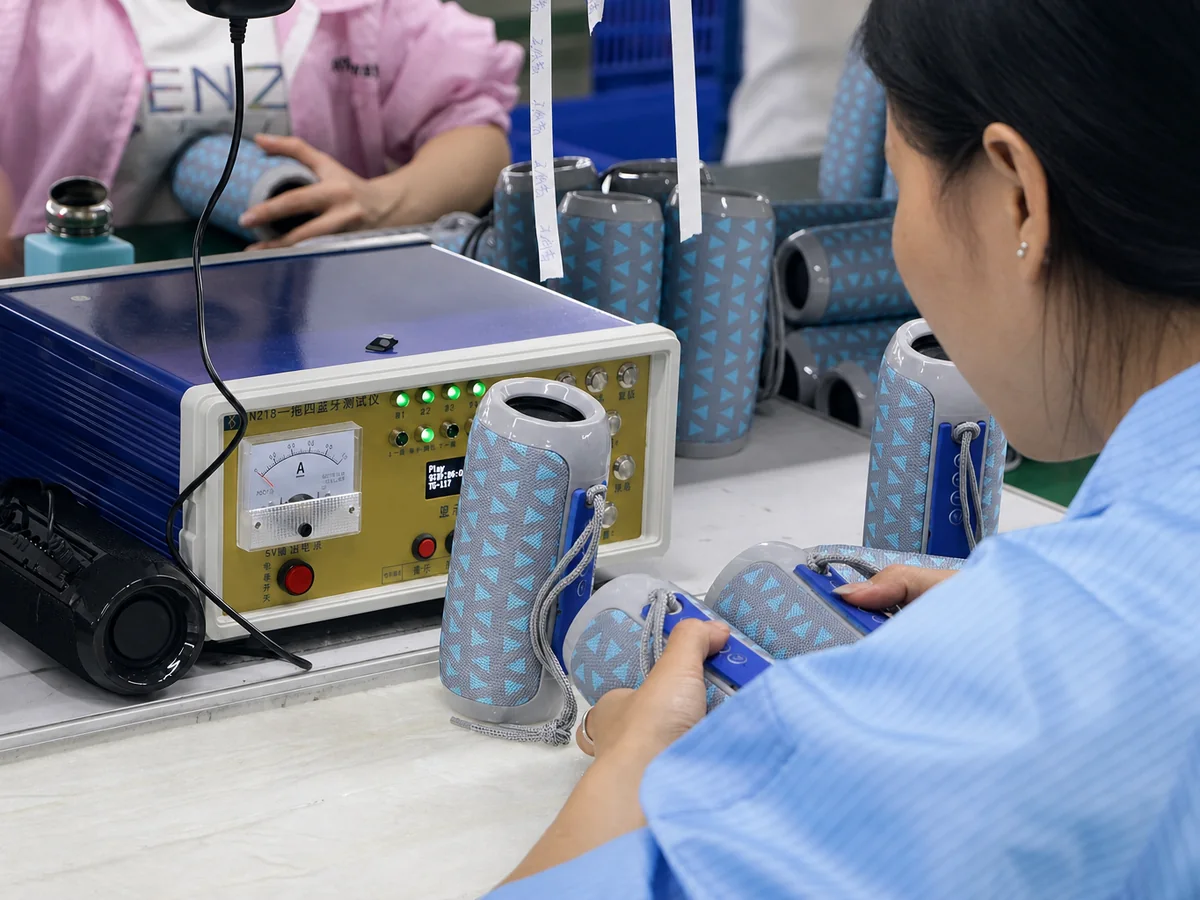
Why the Specification Sheet Is Only the Starting Point
Two speakers may show the same power, battery capacity or Bluetooth version on paper while using different drivers, amplifier settings, batteries, firmware or test methods. Even when the specification is accurate, the result can change with working volume, RGB lighting, audio content and environment.
Before approving a bulk order, buyers should ask three questions for every important specification:
- What exactly does the number or function mean?
- Under what conditions was it tested?
- Will the final production order use the same confirmed configuration?
This approach is more useful than treating the longest feature list as the best purchasing option.
1. Confirm the Exact Model and Approved Configuration
Start by identifying the exact sample, not only the housing or product name. One appearance can sometimes support different configurations. The approval record should cover:
- Model number, housing color and visible product version.
- Speaker driver, amplifier and PCB solution.
- Battery capacity and protection configuration.
- Firmware, prompt language and control logic.
- Bluetooth functions, inputs, ports and included accessories.
- Logo method, label, manual, packaging and barcode version.
A factory quotation should reference the same configuration as the approved sample. If a component or function changes after approval, the buyer should receive the revised information before production.
2. Verify What the Output-Power Figure Represents
Power figures can be presented as continuous or RMS output, peak output, driver rating or another marketing value. These terms are not interchangeable. Buyers should ask the supplier to explain the number and confirm the final driver and amplifier configuration.
A useful sample check includes listening at the intended working volume, checking for obvious distortion, testing several audio tracks and confirming whether protection or volume limiting changes the result. A larger number does not automatically make a model more suitable for a gift, mobile-accessories or e-commerce channel.
For selected high-power projects, power, battery, size, carton weight, transport cost and use scenario should be evaluated together. For portable and mini products, balance and consistency may be more important than the largest printed wattage.
3. Record Battery Runtime With the Test Conditions
Battery runtime changes when the speaker works harder. Higher volume, bass-heavy music, RGB lighting and different connection modes can reduce playback time. A useful battery statement should therefore include its test conditions.
Volume
Record the approximate volume level rather than saying only "normal volume."
Lighting
State whether RGB or another lighting function was on or off during the test.
Playback
Record the content, connection mode and whether the test was continuous.
Buyers should also confirm that the approved sample and the bulk order use the same battery configuration. Battery documents and transport requirements remain model-specific. See the Bluetooth speaker MSDS and UN38.3 guide for related shipping questions.
4. Test the Functions Supported by the Actual Product
A Bluetooth version number does not automatically confirm every profile, codec or feature. Test the functions that matter to the buyer's channel on the final sample:
- Pairing, reconnection and working behavior with common phones.
- Hands-free calling if required.
- TWS or multi-speaker functions if quoted.
- TF card, USB, AUX or other inputs if included.
- Button logic, prompt language, lighting modes and volume steps.
- Charging port, indicator behavior and included cable.
New Bluetooth developments such as LE Audio and Auracast are receiving industry attention, but they should not be added to a product claim unless the selected model's implementation has been verified.
5. Check RGB, Controls and the Product Demonstration
RGB lighting can help a speaker communicate quickly in a listing or short video, but the visual effect should be checked in real operation. Ask for a simple, unedited video showing startup, lighting modes, controls, ports and scale. The footage should match the color and configuration being quoted.
For TikTok Shop, Shopee, Lazada, MercadoLibre and other online channels, buyers should verify that the feature is visible on a phone screen without making an exaggerated claim. Product photos and videos are sales assets, but they are also useful evidence of the agreed configuration.
6. Require Model-Specific Evidence for Durability, IP and Documents
An outdoor design does not automatically prove a specific waterproof grade. A test report, certification file or IP claim should be connected to the exact model and relevant production configuration. Evidence for another speaker should not be treated as proof for the selected product.
Certification and transport-document requirements vary by model, destination and shipping method. Buyers should share their market requirements early and confirm which files are available or still need testing. The supplier should avoid giving one blanket answer for an entire catalog.
7. Use a Golden Sample and Change-Control Record
A golden sample is the final approved reference for the order. It should be linked to a short approval record covering functions, sound, appearance, color, logo, battery, packaging and accessories. The purpose is not paperwork for its own sake; it is to give the factory and buyer one reference when production or inspection questions appear.
Any proposed change to the driver, battery, PCB, firmware, surface finish, color, logo, packaging or accessories should be communicated and reapproved where necessary. This is especially important for repeat orders placed months after the first shipment.
8. Treat Packaging and Carton Data as Product Specifications
The approved product is more than the speaker itself. Confirm the color box, tray or protective material, manual, cable, labels, barcode, carton quantity and shipping mark. Ask for carton size, net weight, gross weight and CBM before finalizing the delivery plan.
Packaging should be checked for both presentation and transport. A gift project may prioritize the unboxing appearance, while an importer may need efficient carton planning and clear warehouse marks. The Bluetooth speaker shipping guide from China explains forwarder delivery and packing information in more detail.
Bulk-Order Verification Checklist
- Confirm model number, color and approved product configuration.
- Clarify output-power definition and working-volume behavior.
- Record battery runtime conditions, including volume and RGB status.
- Test pairing, reconnection, controls, ports and quoted functions.
- Check model-specific evidence for IP, durability, certification or battery documents.
- Approve logo, label, manual, barcode, packaging and accessories.
- Keep a golden sample and record any approved change.
- Confirm pieces per carton, carton dimensions, N.W., G.W. and CBM.
- Agree on the pre-shipment inspection points and evidence.
- Confirm trade term and delivery destination before dispatch.
What Buyers Should Send Before Sample Approval
Share the destination country, buyer type, sales channel, selected model, estimated quantity, target price position, required functions, logo and packaging plan, trade term, delivery destination and document requirements. A clear brief helps a Bluetooth speaker manufacturer or supplier give a model-specific response.
Useful internal links include the T&G product center, OEM/ODM service, factory capability, buyer FAQ and project inquiry form.
How T&G Supports Sample and Specification Confirmation
T&G / Shenzhen Chengtai Electronic Technology Co., Ltd. is a Bluetooth speaker OEM/ODM factory in Shenzhen, China. T&G manufactures portable, mini, RGB, gift, magnetic, custom-logo and selected high-power Bluetooth speakers for importers, distributors, mobile accessories wholesalers, gift companies, e-commerce sellers and private-label buyers.
Depending on the model and project, T&G can discuss sample information, available specifications, custom logo, packaging, product photos and videos, quality checks, carton details, EXW or FOB quotation and delivery to a buyer-appointed forwarder warehouse in China.
Final specifications, price, MOQ, stock, lead time, certification support and shipping documents must be confirmed for the selected model, quantity, market, customization and order date. T&G does not use one universal answer for every product.
Buyer FAQ
Bluetooth Speaker Specification Verification Questions
How can an importer verify Bluetooth speaker output power?
Ask whether the quoted figure is continuous or RMS output, peak output or another marketing value. Confirm the driver and amplifier configuration in the approved sample, then test sound at the intended working volume. Final verification should use the exact production configuration.
Why can Bluetooth speaker battery runtime differ from the specification sheet?
Runtime changes with volume, audio content, RGB lighting, connection mode, battery condition and test method. Record the test volume, lighting status and playback conditions instead of relying on an isolated hour figure.
Does a Bluetooth version number confirm every function?
No. The version number alone does not confirm every supported profile or product function. Test pairing, reconnection, calls, TWS, inputs, controls and any other required function on the final sample.
Should importers accept an IP rating without model-specific evidence?
No. Any waterproof, dustproof, durability or certification statement should be checked for the exact model and production configuration. Evidence from another product should not be reused as proof.
What is a golden sample for a Bluetooth speaker order?
A golden sample is the final approved reference for model, color, functions, sound, battery configuration, logo, packaging and accessories. It helps the buyer and factory compare production against one documented standard.
Can T&G confirm every specification, MOQ and document from this guide?
No. Final specifications, MOQ, price, stock, lead time, certification support and shipping documents must be confirmed for the selected model, quantity, destination, customization and order date.
About T&G
T&G Bluetooth Speaker OEM/ODM Factory in Shenzhen
T&G is a Bluetooth speaker factory in Shenzhen, China. We manufacture portable, mini, RGB, gift, magnetic and custom logo Bluetooth speakers for global B2B buyers.
T&G supports importers, distributors, mobile accessories wholesalers, gift companies, e-commerce sellers and private-label brands with model selection, sample discussion, OEM/ODM, custom logo, packaging and factory quotation support.